Albania Gearing Up for a Promising Summer Tourist Season
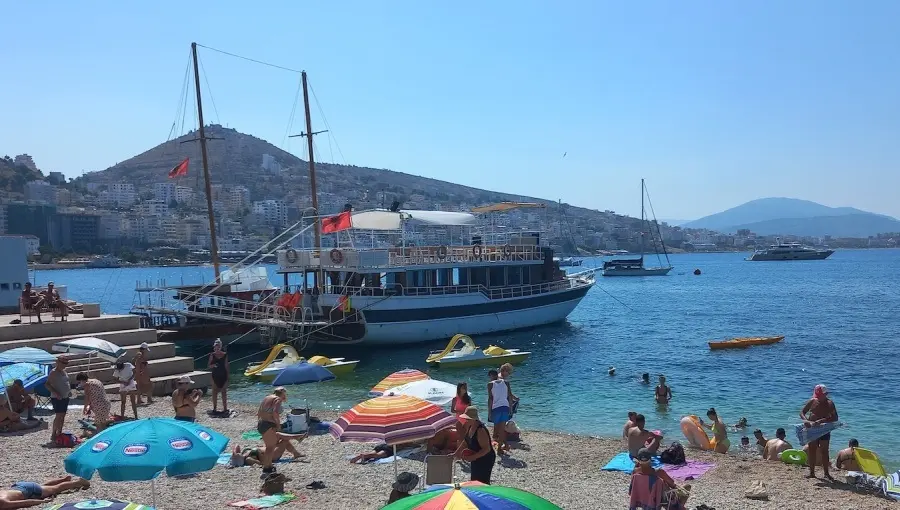
Albania appears to be enjoying a promising tourist season this summer, with holidaymakers’ boats mooring on the beach at Saranda, the coastal town in Vlora County in the south of the country, on an open bay of the Ionian Sea in the central Mediterranean, east of the northern tip of the Greek island of Corfu – making it one of Albania’s best tourist destinations.
A report published by the Balkan Insight network, which specialises in Eastern European and Eurasian affairs, said that photos of Saranda circulating widely on TikTok show it can be hard to find space even for a single towel among the hundreds already covering the rocky beach, as holidaymakers either lie back to relax under the sun or swim in the clear sea water.
Alongside local residents who head to Saranda beach for a quick swim after work, many tourists are arriving from neighbouring Greece and from Albania’s neighbours in the former Yugoslavia, as well as from other European countries who have recently begun flocking to the town.
Although it has long been a popular destination for Eastern European travellers seeking an affordable, relaxing beach holiday, Albania has increasingly topped the list for tourists coming from further afield, as everyone faces economic pressure from inflation and the rising cost of living across Europe – and its reputation as a budget-friendly destination has become its main selling point.
TikTok features a large number of videos celebrating Albania’s appeal as a holiday destination, focusing on its beaches and its bars, which are inexpensive yet stylish, alongside its many UNESCO heritage sites – to the point that some of these videos have racked up more than 60 million views.
With international travel restrictions imposed due to the coronavirus finally lifted this summer season, Albania had already expected a tourism recovery to boost its economy, but the scale of the surge in visitors was still a surprise.
Prime Minister Edi Rama recently said Albania now expects to welcome more than 4 million tourists this year, compared with a previously expected 2.9 million, adding that he believes his country is still missing certain things but is on the right track, given its great restaurants and wonderful street food, and how welcoming it is to visitors – especially after many Albanians returned home following work in Italy’s food industry, which has had a very positive effect on the tourism sector.
Data released by the Albanian statistics office for June showed the number of foreign arrivals to the country rose 45 percent year-on-year, reaching 876,056 visitors. Foreign arrivals from January to June also reached nearly 2.6 million, up 51.3 percent year-on-year.
The largest source of visitors was neighbouring Kosovo, with 394,327 visitors out of total arrivals in June, followed by North Macedonia with around 76,373 visitors. Visitor numbers from both countries rose compared with the same month in 2021.
Much stronger growth was seen in the number of tourists arriving from several other countries, with visitor numbers from Greece, Spain, and the United Kingdom more than doubling compared with June 2021.
Efforts continue to develop tourism infrastructure and attract more visitors to Albania. Until recently there was only one international airport in operation, Mother Teresa International Airport in the capital Tirana. However, the renovated Kukes International Airport opened last summer, and there are plans to build new airports at the tourist hotspots of Saranda and Vlora – though the planned Vlora airport faces strong opposition from environmental groups who want the site moved away from a protected wetland area.
Albanian Prime Minister Edi Rama said during a visit to the city of Korce last year that the Albanian government aims to build the country’s first ski resort there, a city that has already seen continuous development of its tourism offerings in recent years, with several new hotels opening.
Another promising project is the new Durres tourist port, considered one of the largest tourism-related investments in Albania, which will replace the old industrial port in front of the city, to be relocated elsewhere.
On a smaller scale, there are many local investments aimed at making tourist destinations more attractive, though much still remains to be done, as the influx of hundreds of thousands of tourists puts a strain on the infrastructure of Albania’s coastal towns and villages. Albania also faces an urgent need to invest in infrastructure, from transport to energy to municipal services.
Albania also suffers from a number of other problems, such as waste disposal, as is the case in other Western Balkan countries, where waste production has increased sharply in recent decades while waste management infrastructure has generally failed to keep pace.
Safety is another source of concern: three beachgoers were killed this summer after being struck by speedboats or jet skis, which dangerously veer close to swimmers on many of Albania’s beaches. The death of a seven-year-old girl after being struck by a speedboat this August sparked several protests, with residents blaming state authorities for failing to ensure such accidents do not happen.
Despite these challenges, industry workers and tourism experts believe there is enormous potential to expand the types of tourism Albania offers, beyond traditional holidays. Aside from the country’s UNESCO World Heritage sites in Berat, Butrint, and Gjirokaster, there is also potential for adventure tourism, nature-based destinations, rafting, hiking, horseback riding, and other types of holidays.