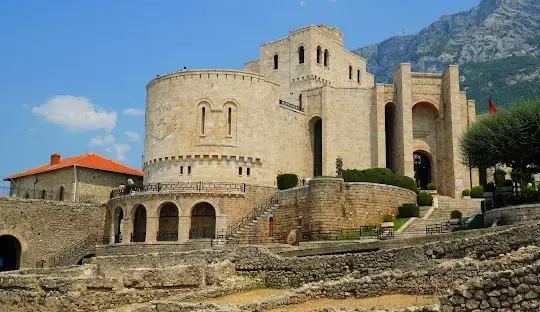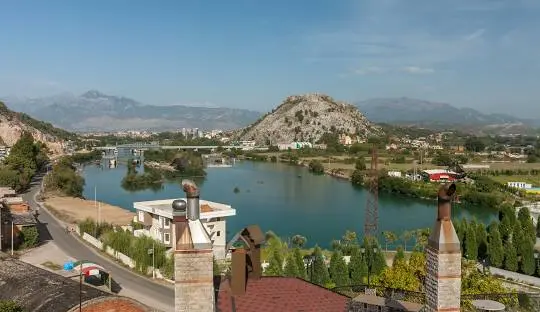
Shkoder, historically known as Scodra or Scutari, is the fifth-largest city in the Republic of Albania and the capital of both Shkoder County and Shkoder Municipality. Settlement in Shkoder dates back to the early Bronze Age (around 2250-2000 BC), giving it roughly 2,200 years of recorded history. The city spreads across the Bregu i Bunës plain between the southern part of Lake Shkoder and the foothills of the Albanian Alps, along the banks of the Buna, Drin, and Kir rivers. Due to its proximity to the Adriatic Sea, Shkoder has a seasonal Mediterranean climate with continental influences.
An urban settlement called Scodra was founded by the Illyrian Labeatae tribe in the 4th century BC. It became the capital of the Illyrian kingdom under the Ardiaei and other Illyrian tribes, and was one of the most important cities on the Balkan peninsula in antiquity. It historically developed on a 130-metre-high hill, a strategic site at the point where Lake Shkoder meets the Buna River. The Romans annexed the city after the Third Illyrian War in 168 BC, when the Illyrian king Gentius was defeated by the Roman force under Anicius Gallus. In the 3rd century AD, Shkoder became the capital of Praevalitana, under the administrative reforms of Roman Emperor Diocletian. With the spread of Christianity in the 4th century AD, the Archdiocese of Scodra was established, and in 535 it came under the authority of Byzantine Emperor Justinian I.
Shkoder is considered the traditional capital of northern Albania, an area also referred to as Gegëria, and is noted for its arts, culture, religious diversity, and turbulent history among Albanians. Shkoder’s architecture is dominated largely by mosques and churches reflecting the city’s degree of religious diversity and tolerance. Shkoder was home to a number of influential figures who, among others, helped shape the Albanian National Awakening.